
Minister of Housing, Infrastructure and Communities Transition Binder (2025)
Book 3: Capacity and Evolution of HICC
Section A: Capacity and Evolution of the Department
HICC is built to deliver on evolving priorities, harnessing capacity and experience
- Over a relatively short history, the Department has delivered an array of programming types and funded a wide variety of asset classes.
- Infrastructure – from large transfers via provincial agreements to targeted application-based programs and alternative finance models.
- Housing and homelessness – leading housing policy work to advance Canada’s Housing Plan, in close partnership with CMHC on program delivery, and providing federal funding to support community-based homelessness responses.
- Demonstrated capacity to adapt, pivot, and align to prevailing economic and partner needs and contexts.
- From time-limited and narrow-purpose funds to long-term, predictable programs.
- Relationships and credibility built with other levels of government and with sector players.
- Capacity for economic analysis, intelligence on regional infrastructure and housing needs had been deepened over time.
Whether providing stimulus-type relief, building in areas of strategic long-term need, or addressing the housing supply and affordability crisis, HICC has swung into action to meet the moment.
How we invest: Policy and program tools to be deployed
- The housing and infrastructure portfolio leverages a range of funding and delivery tools. The portfolio has the potential to explore additional funding mechanisms, or funding/delivery tool combinations, as needed.
- HICC is an established G&Cs funder with experience in PTM agreements, direct delivery and transfer payments.
- Conditionality on infrastructure funding to achieve housing and housing-adjacent outcomes.
- Alternative or flexible financing options are also available via CMHC and CIB to deliver housing and revenue-generating infrastructure projects.
- Different tools are better suited to different assets. The portfolio is flexible and can adjust how it funds projects, depending on the project in question.

-
Figure 1 - Text version
Housing and infrastructure funding and delivery toolkit
- Grants
- Contributions
- Loans
- Repayable contributions
- Alternative financing
Funding tool
- Transfer
- Third-party delivery
- Direct delivery
- PTM agreement
- Site-specific agreement
- P3 delivery
Delivery tool
Investment in housing and infrastructure.
What we invest in: Many asset classes, housing solutions
- Current infrastructure programming focuses on a few asset classes:
- Housing-enabling water, wastewater, solid waste (Canada Housing Infrastructure Fund)
- Public transit and active transportation (Canada Public Transit Fund)
- Community buildings and assets (Green and Inclusive Community Buildings)
- Resilient infrastructure (Disaster Mitigation and Adaptation Fund)
- A broader range of 19 project types – e.g., transit, wastewater, local roads/bridges (Canada Community-Building Fund, ongoing)
- Housing programming spans the housing spectrum:
- Building more homes, making it easier to own/rent and increasing affordable housing (Apartment Construction Loan Program, Housing Accelerator Fund, etc.)
- Ending chronic homelessness (Reaching Home, etc.)
- The department has an extensive history of delivering both broad-based and targeted programs targeting different outcomes through infrastructure investment, including the following legacy programs:
- Long-term, stable infrastructure funding for communities (Investing in Canada Infrastructure Program)
- Focus on economic growth, job creation and productivity (Building Canada Fund and New Building Canada Fund)
- Modernizing our border infrastructure (Border Infrastructure Fund)
Annex: HICC’s evolving mandate
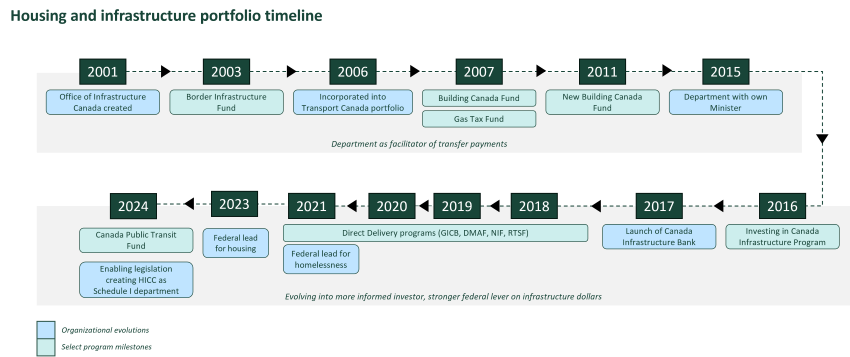
-
Figure 2 - Text version
Housing and infrastructure portfolio timeline
Department as facilitator of transfer payments
- 2001: Office of Infrastructure Canada created
- 2003: Border Infrastructure Fund
- 2006: Incorporated into Transport Canada portfolio
- 2007: Building Canada Fund | Gas Tax Fund
- 2011: New Building Canada Fund
- 2015: Department with own Minister
Evolving into more informed investor, stronger federal lever on infrastructure dollars
- 2016: Investing in Canada Infrastructure Program
- 2017: Launch of Canada Infrastructure Bank
- 2018 – 2019 – 2020 – 2021: Direct Delivery programs (GICB, DMAF, NIF, RTSF)
- 2021: Federal lead for homelessness
- 2023: Federal lead for housing
- 2024: Canada Public Transit Fund | Enabling legislation creating HICC as Schedule I department
Annex: What we invest in

-
Figure 3 - Text version
Portfolio Partners
- Pont International Gordie Howe International Bridge
- CIB-BIC
- Waterfront Toronto
- CMHC-SCHL
- Pont Jacques Cartier – Champlain Bridges
- WDBA – APWD
- Windsor-Detroit Bridge Authority | Authorité du Pont Windsor-Detroit
Housing and infrastructure portfolio
- Green and Inclusive Community Buildings
- Canada Community Building Fund Endnote *
- Canada Public Transit Fund
- Canada Housing Infrastructure Fund
- Canada Secondary Suite Loan Program
- Housing Design Catalogue
- Apartment Construction Loan Program
- Federal Lands Initiative
- Affordable Housing Fund
- Co-op Housing Development Program
- Canada Rental Protection Fund
- Reaching Home: Canada’s Homelessness Strategy, Veteran Homelessness Program & Unsheltered Homelessness & Encampments Initiative
- Canada Infrastructure Bank
(Bottom of the page)
- Community, culture, tourism, sport, recreation assets
- Highways, local roads, bridges
- Water, wastewater, solid waste
- Non-market & homelessness solutions
- Housing-enabling infrastructure and solutions
- Public transit
- Market housing solutions
- Revenue-generating infrastructure
Page details
- Date modified: