
The Gordie Howe International Bridge
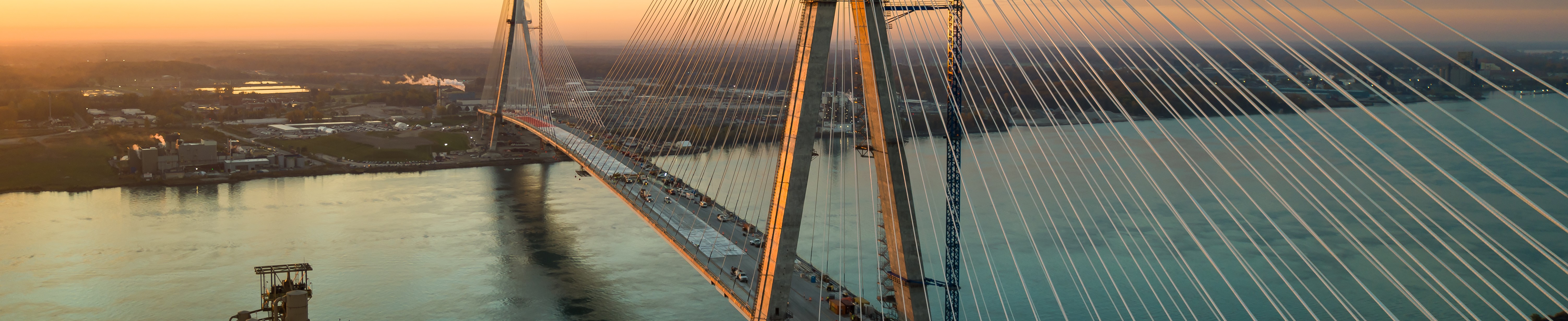
The Gordie Howe International Bridge is now open!
On this page
About the project
Seamlessly connecting North America, the Gordie Howe International Bridge which opened on July 27, 2026, is home to the largest land ports of entry between Canada and the United States, transforming how trade moves through the Windsor-Detroit corridor.
The Gordie Howe International Bridge provides additional capacity with six lanes and a multi-use path, supporting trade and encouraging investment between Canada and the United States.
Key features include:
- Highway-to-highway connection
- Greatest number of traffic and inspection lanes
- Dedicated lanes for trucks and oversized loads
- Easy toll collection
- State-of-the-art technology and route optimization tools
- Faster processing with on-site secondary inspection
The bridge is publicly owned by both Canada and Michigan, and delivered by Windsor-Detroit Bridge Authority through a public-private partnership (P3).
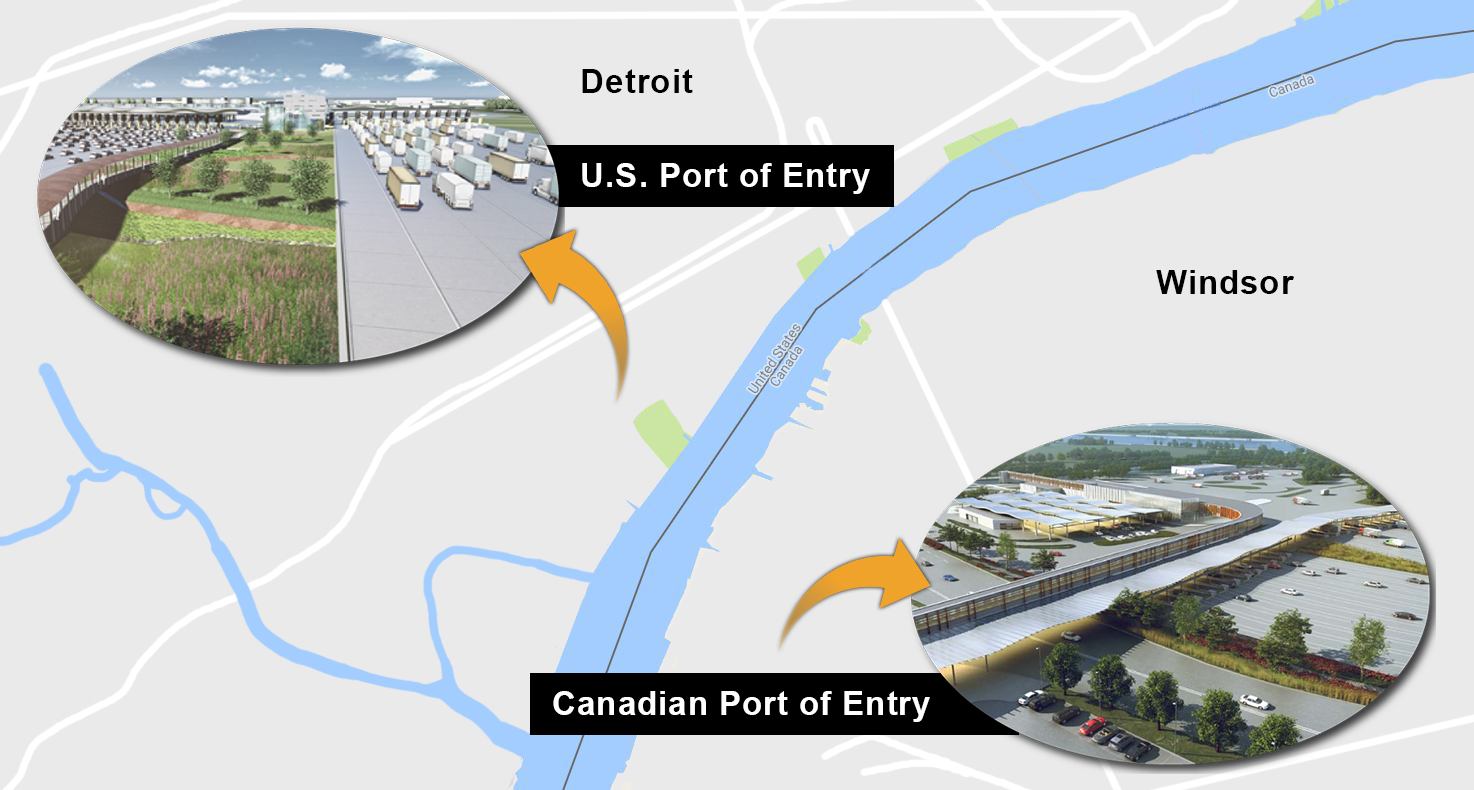
Aerial view of Gordie Howe International Bridge Ports of Entry
Project components
- Gordie Howe International Bridge: Single span structure with six lanes for vehicular traffic, and a multi-use path to accommodate pedestrians and cyclists
- Canadian Port of Entry: 53-hectare site
- U.S. Port of Entry: 68-hectare site
- I-75 Interchange: New connection to Interstate 75 in Michigan
Economic prosperity
With direct connections to Ontario's Highway 401 and Michigan's Interstate 75, the bridge provides the capacity to increase trade and encourage investment between Canada and the U.S., supporting the largest bilateral trading relationship in the world.
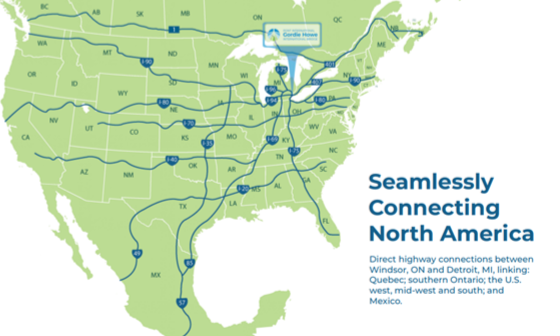
Direct highway connections between Windsor, ON and Detroit, MI, linking: Quebec; southern Ontario; the U.S. west, mid-west and south; and Mexico.
Text version
Cette image est une carte de l'Amérique du Nord montrant les principales autoroutes reliant le Canada, les États-Unis et le Mexique. Au centre de la carte se trouve le pont international Gordie-Howe, qui relie Windsor (Ontario) au Canada à Détroit (Michigan) aux États-Unis.
Des lignes bleues partent de ce point central et représentent les principales autoroutes reliant de nombreuses régions importantes, notamment :
- Le sud de l'Ontario et le Québec au Canada;
- Le Midwest des États-Unis (comme le Michigan, l'Ohio et l'Illinois);
- Le sud des États-Unis (comme le Texas, la Géorgie et la Floride);
- L'ouest des États-Unis (comme la Californie et l'Arizona);
- Et jusqu'au Mexique.
Sur le côté droit, un message indique : « Connecter l'Amérique du Nord en toute transparence - Liaisons routières directes entre Windsor (Ontario) et Détroit (Michigan) reliant: le Québec; le sud de l'Ontario; l'ouest, le Midwest et le sud des États-Unis; et le Mexique. »
Roles and responsibilities
The Government of Canada financed the entire project, with its investment to be recovered through toll revenue.
Housing, Infrastructure and Communities Canada is responsible for providing oversight and due diligence to ensure the project continues to comply with government direction and with the 2012 Canada-Michigan Crossing Agreement.
Canada Border Services Agency and the Canadian Food Inspection Agency will occupy and assist in operations of the Canadian Port of Entry.
Headquartered in Windsor, Ontario, Windsor-Detroit Bridge Authority (WDBA) is a not-for-profit Canadian Crown corporation which reports to Parliament through the Minister of Housing and Infrastructure.
WDBA is responsible for the implementation of the project, which is being delivered through a public-private partnership (P3).
WDBA selected the P3 partner and manages the P3 project agreement, and is responsible for project oversight including construction and operation of the new crossing.
Follow WDBA on social media:
Page details
- Date modified: