
Evaluation of the Research and Knowledge Initiative
Copyright
© His Majesty the King in Right of Canada, as represented by the Minister of Housing and Infrastructure, 2026.
Cat. No. T94-124/2026E-PDF
ISBN 978-0-660-99465-9
Table of contents
- Executive summary
- Program context
- Evaluation context
- Findings
- Conclusion and considerations
- Annex A: Additional program information
- Annex B: Methodology and limitations
- Annex C: Methodology and Limitations
Executive summary
This report presents the findings of the Evaluation of the Research and Knowledge Initiative (RKI), covering the period from November 2018 to July 2024. The purpose of the evaluation was to examine the relevance and effectiveness of the RKI program. It also examined lessons learned and promising practices from the RKI and similar research-focused programming in the federal government to inform future decision-making of research initiatives and programming at Housing, Infrastructure and Communities Canada (HICC), considering the department's expanded mandate.
Key findings
- The RKI supports government and department priorities to strengthen evidence-based decision-making and foster innovation and partnerships in the Canadian infrastructure space.
- Based on early results and a limited number of completed projects, RKI projects are on track to meet the immediate outcome. The performance indicators could be improved for clarity and feasibility of measurement.
- The RKI adapted and made improvements during the program where possible. However, short program timelines and administrative requirements hindered the effective delivery of funded projects.
Conclusion
Overall, the evaluation found that the program maintained its relevance to government and department priorities. Developing the program's knowledge-sharing role and ensuring HICC-funded research does not duplicate other funded research would contribute to continued relevance.
The program was able to improve some administrative issues during its lifecycle despite a context of short turnarounds between its two phases and of rapid growth and change at the Department. However, addressing reporting and other administrative challenges in future iterations of this, or similar programs, would respond to current and pressing needs for timely research. Given the timing of the evaluation, only early results based on a limited number of completed projects were available. These early results show that funded projects are on track to meet the immediate outcome of increasing partnerships, research collaborations and knowledge-sharing opportunities. The clarity and feasibility of the program's performance measurement (i.e., definitions and feasibility/relevance of indicators for measuring intended research outcomes) would benefit from pursuing the performance measurement review already started by the program.
This engagement also identified potential approaches for future research programming based on the program's own lessons learned and promising practices for research programming in other federal government organizations (i.e. complementary tools for different scopes, scales and timelines of projects).
Considerations
Funding for the RKI program has been fully allocated and the program will end in March 2026, therefore there are no recommendations in this report. However, the evaluation provides the following considerations to inform any renewal of research-focused programming:
- Define future research role and research programming objectives in alignment with the Canada Mortgage and Housing Corporation (CMHC) and other relevant federal departments, agencies and Crown corporations.
- Consider leveraging HICC's role as a federal entity to develop a coordination function of research programming on infrastructure, housing and homelessness across federal departments and with external organizations like CMHC. This could include developing HICC's knowledge-sharing role by formalizing existing practices within the team around developing connections and networks across RKI projects, policy research at HICC and other research initiatives within and outside HICC.
- Ensure the funding model, outcomes and indicators for future research programming are coherent with program and research-related objectives for clear and consistent reporting that demonstrate research impacts.
- Future research programming should be developed with clear objectives and a defined research agenda to streamline design and application process, removing administrative burdens and ensuring the delivery of timely and relevant research.
Program context
Program description
The RKI is a national merit-based contributions program. It funds research projects aimed at generating knowledge and advancing understanding of infrastructure and housing needs and challenges relevant to Canadians to support evidence-based decision-making. The majority of the RKI projects were solicited through two competitive open calls for proposals (CFPs), accepting a wide-set of eligible applicants and activities. Projects were assessed by an internal committee with subject-matter experts, including the CMHC during Phase 2, to create a shortlist for the minister's final selection.
Funding profile
The program was approved in 2019 with $10 million in contribution authorities until 2024. The first intake of projects for Phase 1 was in 2021.
In October 2022, the program was extended to 2024-25.
$3.6 million was allocated towards two unsolicited projects approved before the first call for proposals and completed in 2022. The remaining $6 million supported the 12 RKI Phase 1 projects.
In April 2023, a second phase of the RKI was allocated an additional $10 million over 3 years to 2026.
For a list of all Phase 1 and Phase 2 projects with their allocated funding, please see Annex A.
Project financial information
The minimum eligible project cost was $250,000 for Phase 1 across the full period of the project. The funding maximum for a single recipient per fiscal year was $600,000. In Phase 2 the amount payable per recipient was increased to a maximum of $1 million per fiscal year and the minimum project cost for eligibility was reduced to $200,000 to broaden project size eligibility. For a full list of research activities that were eligible for Phase 1 and Phase 2 project costs, please see Annex A.
Stacking assistance and cost-sharing requirements for both phases
At least 30% of total eligible project costs had to be supported by a non federal funding source as federal funding must not exceed 70% of total eligible expenditures. Projects led by Indigenous organizations, or the Yukon, Northwest Territories and Nunavut governments were entitled to funding up to 100% of total eligible costs.
Eligible applicants
Canada
- Non-governmental (not-for-profit) organizations, including:
- Industry, research, and professional associations
- National Indigenous organizations and Indigenous communities
- Community and regional organizations
- Other non-profit organizations
- Academic institutions
- Provincial, territorial, regional, municipal or Indigenous governments
- Private (for profit) organizations
International
- Industry, research and professional organizations
- International organizations (e.g., Organisation for the Economic Cooperation and Development)
- Academic institutions
- Other non-profit organizations
Program phases
The first phase (Phase 1) opened a call for proposals in August 2021 and focused on projects that strengthened the development and use of community-level data and research on public infrastructure across Canada. Seventy-eight out of 95 applications met the eligibility criteria. The 12 approved projects from this phase covered these themes:
- 2 Transit & mobility projects
- 3 Open data for decision-making & community engagement projects
- 7 Climate resilience projects
The second phase (Phase 2) of the RKI was marked by an emphasis on housing given the expanded mandate of HICC. The open call for proposals focused on applied research that examines specific interventions and contributes to solutions for addressing Canadian housing and infrastructure needs. Ninety of 104 applications met the eligibility criteria. The 18 approved projects covered these themes:
- 2 Homelessness projects
- 3 Housing and transit projects
- 12 Housing projects
Evaluation context
Objective
The RKI evaluation meets the Treasury Board's 2016 Policy on Results requirement to conduct an evaluation as a result of a program commitment. The evaluation's objective is to examine the relevance and effectiveness of the program as defined by the Treasury BoardFootnote 1, as well as to identify lessons learned and promising practices to support potential future research programming redesign at HICC.
Scope
The evaluation covered the period from November 1, 2018, to July 15, 2024. Within this scope, the evaluation examined aspects of the design and delivery of the RKI from both phases of the program. Given that most Phase 1 projects were ongoing and Phase 2 projects had not started by July 2024, the evaluation examined progress towards the immediate outcome only. The evaluation covered the 12 projects from Phase 1 and the 18 projects from Phase 2 that were selected in the context of the two calls for proposals.
Methodology
The evaluation's methodology used four lines of evidence to gather information in support of the findings: document review, literature review, data review and interviews. The analytical methods were tailored to the nature of the data available, and the evaluation design and level of effort were calibrated with available HICC resources. The full methodology is available in Appendix B.
Evaluation questions
The evaluation questions addressed two areas of interest based on the Policy on Results – relevance and effectiveness – as well as continuous improvement. The evaluation questions were:
Relevance
- How does the RKI support HICC's mandate?
Effectiveness
- To what extent is the RKI's design and delivery effective at achieving its immediate outcome?Footnote 2
Continuous improvement
- What are the lessons learned, promising practices and alternative program models that could help enhance the RKI in terms of relevance and effectiveness?
Findings
Key finding 1: The RKI supports government and department priorities to strengthen evidence-based decision-making and foster innovation and partnerships in the Canadian infrastructure space.
The RKI's broad and flexible design enabled continued alignment with departmental mandate and priorities
Initially positioned at program launch to contribute to broader government outcomes of economic growth and a clean and healthy environment, the evaluation found that the RKI supported departmental priorities to strengthen the evidence base and knowledge on Canadian infrastructure and communities, contributed to support policies and decision-making in these areas, and built capacity and promoted partnerships with other levels of government and key stakeholders in the Canadian infrastructure space. Program documents show that the RKI funded projects in climate resilience, transit and mobility, and open data for community decision-making on infrastructure issues in Phase 1 aligned with these initial priorities. In Phase 2, the program evolved and maintained its relevance by responding to changes in the department's mandate and priorities to includehousing and homelessness as eligible funding areas and emphasizing a need for applied research. This continued alignment with priorities in both phases was further confirmed in interviews with program staff.
By funding research in areas within the broader mandate of HICC, the RKI contributes to Canadian research on infrastructure, housing and homelessness and to a greater understanding of the research landscape by the Department. As a pioneering program at the Department that funds research, knowledge and innovation on Canadian infrastructure, housing and homelessness issues, the RKI also contributes to roles and responsibilities to “undertake, coordinate and promote research activities” as established in the Department's enacting legislation. By bringing together academia, government, non-profit and industry, the program's design supports cross-sector collaboration and knowledge exchange across and beyond academic, private, public and not-for-profit sectors. This role contributes to disseminating research to broader audiences and increasing the potential for uptake and social contribution of funded research according to literature on connecting research to policy-making (Duiveman 2020; Kochenkova, Grimaldi & Munari 2016; Levin 2008). The program's relevance thus arises in part from contributing to knowledge mobilization and dissemination according to both literature and program and recipient interviews, and could be strengthened by further developing this role.
There is a continued need to align research focus and prevent duplication risk
The RKI's broad and flexible design enabled the program to evolve and maintain its alignment to emerging priorities and needs at HICC, such as pivoting and allocating 100% of Phase 2 funding towards research in housing and homelessness. However, analysis of documents and interview evidence suggests that developing a consistent research focus in alignment with HICC priorities would help define future research programming's parameters for potential applicants. This could enhance the program's stability and intended purpose in the Canadian research landscape.
In addition, while the RKI's contributions model broadly complements rather than duplicates existing research funding programs internally and externally, there is some risk of duplicating research funding by other organizations already well established in funding and developing research in infrastructure, housing and homelessness. For example, Action Research on Chronic Homelessness (ARCH) within HICC is a National Housing Strategy initiative that conducts action research with communities across Canada on homelessness, whereas the Research and Data Initiative – a CMHC initiative – includes several programs aimed at enhancing housing data and research. While documents and interviews indicate that the risk of overlap between internal and federal programs like these and the RKI is being managed by the program through meeting and consulting with internal and external counterparts, there is an ongoing need to monitor and prevent this risk as HICC's mandate and work in the infrastructure and housing spaces continue to develop and expand.
Key finding 2: Based on early results and a limited number of completed projects, RKI projects are on track to meet the immediate outcome. The performance indicators could be improved for clarity and feasibility of measurement.
The immediate outcome for the program is to increase partnerships, research collaborations and knowledge-sharing opportunities to generate research, thinking and solutions for public infrastructure, communities, housing affordability and homelessness priorities. It is measured by two indicators:
- Number of new partnerships and collaborations developed that bring researchers (and their expertise) together with communities and decision-makers.
- Number of collaborative opportunities and knowledge-sharing (dissemination) activities developed/implemented as a result of funded research (e.g., workshops, conferences, engagement tools).
Early results show progress towards the immediate outcome for completed and ongoing projects
The program's design includes elements that create conditions for the development of partnerships and knowledge-sharing for selected projects. There are requirements for 30% outside funding for most projectsFootnote 3, generally resulting in at least one partner per project proposal, although these are rarely reported as new. In addition, applications were assessed by the program on their proposed plans for potential partnerships and knowledge-sharing strategies once they were screened as eligible.
Results for the immediate outcome were available for the two completed Phase 1 projects, reporting the development of two and four partnerships and 30 knowledge-sharing (dissemination) activities for each according to the program. The remaining 10 Phase 1 projects were ongoing and did not have final counts of their progress towards this outcome. However, progress reports and recipient interviews indicate that these projects engaged in partnerships and/or strengthened collaboration with municipalities, Indigenous communities, academic institutions and students, private organizations and/or NGOs. Additionally, projects reported participation in project-related activities for knowledge-sharing such as conferences, webinars, media interviews and workshops, thus contributing to progress.
The evaluation assessed Phase 2 project plans for partnerships and knowledge-sharing activities. Most projects identified one to two potential partnerships and highlighted other key stakeholder groups for further collaboration. Their planned events include workshops, courses, and conference presentations.
For knowledge-sharing activities, the RKI team organizes events including presentations on projects for recipients, which create opportunities to foster new collaborations and disseminate project findings. However, these events are not a formalized part of the program, are not systematically available to all recipients, nor are they reported by recipients as progress towards the immediate outcome. This suggests the likelihood of projects underreporting work towards the immediate outcome that is not initially set out in the proposal's knowledge-sharing plan.
Limits to assessing progress for ongoing RKI projects
The indicators chosen to measure the immediate outcome are not defined in program materials and were found to be unclear to both recipients and program staff at the time of evaluation. There were no reporting templates or example materials for recipients to use, resulting in self-interpreted narrative application of the indicators to project work. There are variable timing requirements for reporting on indicators across both phases. In addition, based on the evaluation's analysis of the two completed Phase 1 projects within the scope of the evaluation, the final reporting excludes the requirement to count the number of new partnerships. As a result, these challenges impacted the ability to accurately account for progress on the immediate outcome for both completed projects according to the chosen indicators. They will also affect future assessments of progress on the immediate outcome as it is unclear if outcomes are being measured consistently by recipients across projects and phases. The program was able however to confirm the number of partnerships and knowledge-sharing activities for the two completed Phase 1 projects reported in this evaluation.
Although the program was able to report on the immediate outcome by confirming these numbers, the indicators chosen offer only a partial understanding of this outcome. Indeed, both indicators only account for the quantitative dimensions of the immediate outcome by counting the number of new partnerships and knowledge-sharing activities without specifying the desired targets for these numbers. This does not capture other aspects of the outcome that may contribute to telling a more complete success story for the types of projects in the program and limits the ability to assess whether numbers obtained represent a success. Examining other dimensions of partnerships and knowledge-sharing activities, such as the reach of knowledge-sharing activities or the type of partnerships, would more fully account for projects' progress on the immediate outcome as they build towards the program's longer term project outcomes. For ongoing Phase 2 projects, clarifying definitions of the indicators would enhance the utility of information captured for tracking results in future and final reports.
Completed projects highlights
Measuring Main Streets: A data-driven project to better understand Canadian main streets
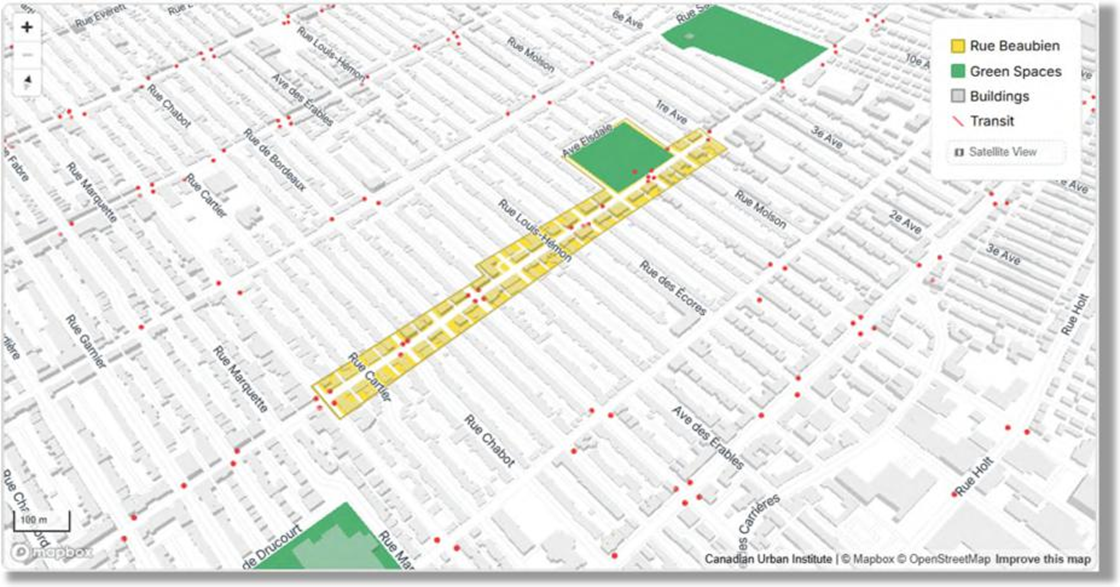
Example of civic infrastructure index tool for Montréal
Source: Measuring Main Streets
30 Knowledge-sharing activities
2 partnerships:
The Measuring Main Street project began in June 2022 and formally launched in June 2024. Led by a project team from the Canadian Urban Institute (CUI), the Measuring Main Streets project developed a publicly available platform that provides data and analysis on the role of civic infrastructure in creating and maintaining vibrant main streets in Canadian communities. The platform consists of an interactive map of all main streets in Canada, thematic and regional research briefs, detailed main street case studies, and a set of data and visualization tools. The website is available as a public research hub on main street resiliency and can be used for business improvement and to inform infrastructure investment across Canada.
Supporting climate risk mitigation for municipalities with nature-based infrastructure
The Supporting climate risk mitigation for municipalities with nature - based infrastructureproject was led by the New Brunswick Environmental Network's (NBEN) and focused on informing decision-makers and providing tools, training, and a framework on effective nature-based climate solutions to strengthen New Brunswick's local capacity-building at the municipal level. The project took place from June 2022 to March 2024 and included the following:
- A public opinion survey to gauge New Brunswick's residents understanding and support of nature-based climate solutions.
- Engagement sessions with municipal staff, elected officials and community leaders in New Brunswick to share resources and perspectives.
- A benefit - cost analysis (BCA) tool to support decision-making that was piloted for two case studies with the City of Dieppe and the Rural Community of Beausoleil. The BCA framework and tool are available to the public on the NBEN website to facilitate decision-making on future climate risk mitigation for communities in New Brunswick.
30 Knowledge-sharing activities
4 partnerships:
- Nature NB
- CLIMAtlantic
- Union of municipalities ofNew Brunswick
- Francophone Association of Municipalities of New Brunswick (Avaliable in French only)
What is nature-based infrastructure?
Nature-based infrastructure is an adaptive climate change solution through the implementation of infrastructure that restores and protects nature, removes greenhouse gasses, reduces flooding and stormwater surge risks, and supports biodiversity.
Key finding 3: The RKI adapted and made improvements during the program where possible. However, short program timelines and administrative requirements hindered the effective delivery of funded projects.
The RKI's ability to adapt
The program collected and integrated lessons learned where possible, showing an ability to improve and adjust to better meet program needs and accessibility during its lifecycle.
Among these changes, the program lowered the threshold for eligible project costs from $250,000 to $200,000 in Phase 2 to increase the program's accessibility to smaller organizations and projects. To accommodate the larger and costlier projects in applied housing research in Phase 2, the program raised the maximum allocated funding per year from $600,000 to $1,000,000.
Following feedback on the application process in Phase 1, the RKI developed webinars and a Frequently Asked Questions (FAQs) section on the RKI web page for Phase 2 applicants. Along with the program's responsiveness, support and outreach, these tools enhanced applicants' and recipients' experiences of the program according to documented and interview feedback and represent promising practices that could be carried over to future research programming.
The program encouraged projects collecting and/or making use of First Nations data to integrate First Nations principles of ownership, control, access and possession (OCAP)Footnote 4 in their Phase 2 applicant guide. This change to application guidelines partially addressed concerns raised by recipients around First Nations data sovereignty and the inclusion of equity considerations in projects. The program also made adjustments to reporting requirements by allowing oral reporting for Indigenous organizations in some instances. This was viewed positively, however, a documented and transparent approach to the use of reporting flexibilities like oral reporting would increase the value of this practice.
Timeline concerns
Evidence from program documents and interviews with recipients and program staff highlight concerns regarding short application and project timelines for both phases, which were seen as restrictive for research-intensive initiatives tackling infrastructure challenges, particularly for projects employing methodologies and data sources such as ethnographies, community data, or applied proof of concepts and piloting.
According to recipients, the timelines were not aligned with the programs' objective for projects to drive relationship-building amongst key infrastructure actors, as this type of engagement takes time. The short announcement-to-application window (approx. 1 month for Phase 1 and no time for Phase 2) and call for proposal periods (2 months for both) suited higher capacity applicants with experience in proposal-writing and active networks for identifying partnerships in the time allowed. Universities were particularly at an advantage during the application phase as they could rely on their own research staff and centres for additional support during their project's application vs. smaller community-based NGOs or for-profit organizations with few project organizers.
Although recipients had the opportunity to start work and claim funds retroactively, time taken to negotiate contribution agreements, particularly in Phase 1 (average of 7 months compared to about 4 months in Phase 2), further shortened most project timelines, leaving less time for the research than originally anticipated. In Phase 1, the funding timeline was extended to March 2025 in part to recognize longer agreement negotiations. Although Phase 2 negotiations were shorter, the Phase 2 timeline is only 22 months and cannot be extended due to the program's fixed end in 2026. This short funding window likely limited larger projects from applying. Additionally, at least one Phase 1 recipient will need to continue working after the project completion date and without funding. A longer program lifecycle has been recommended by various key informants and literature (Zacharewicz et al. 2023) as a best practice to better sustain an environment for high quality research.
Challenges with pacing of administrative requirements

-
Text description
Circle graph representing the count of recipient types across both phases of RKI by sector. Fourteen out of thirty are academic recipients, representing 47% of RKI recipients and the largest share. This percentage is highlighted by a graduation cap icon. Not-for-profit organizations account for 9 recipients, followed by for-profit organizations with 5, and government organizations with 2, representing the smallest share.
The RKI program's design adopted the department's predominant contributions model for high dollar infrastructure programs. The evaluation found that HICC's administrative requirements, while designed for rigorous oversight, were frequent and burdensome for most RKI recipients.
Recipients are required to submit payment claims and reports on their projects every three months, annually, and upon project completion, in addition to reporting at Agreement Management Committee (AMC) meetings. According to program staff and most recipients, the extent and pace of reporting was onerous and time-consuming, posing a risk to timely project progress. The value of this frequent reporting was also questioned by most recipients, as it created redundancies and was not perceived to have improved project performance. For example, most early progress reports lacked significance due to early projects' statuses, and the same information was relayed to program staff at the AMCs. For academic recipients, who form the largest portion of RKI recipients (see Figure 1), the program's administrative processes conflicted with their institutions' own requirements, leading to delays in project starts in Phase 1. For example, despite receiving HICC approval to start projects, academic recipients were generally prohibited by their institutions to spend funds prior to signing agreements.
The program began modifying payment claims processes in Phase 1 and reduced Phase 2 quarterly reporting requirements. However, the evaluation was unable to assess the success of the changes for either phase and particularly for Phase 2 as projects had not started reporting within the scope of the evaluation. Findings from past evaluations of similar federal research programs support calibrating reporting requirements to the financial risk of recipients and funding value, as well as ensuring reporting requirements allow for the complexity of measuring the performance of research-based programs. This could be considered a promising practice for future or similar research programming at the department.
Potential research design approaches
Improvements made by the program were well-received but limited by the quick turnaround between Phases 1 and 2 and the short overall application and project timelines for both phases. In addition, the RKI is ending in 2026. Considering this, and based on promising practices from other federal government research programs and academic literature, there are opportunities for future research programming:
Role in knowledge-sharing
There is an opportunity for the program to build on its current initiatives to share RKI research by further developing this role in support of knowledge-sharing, both internally to support policy and programming at HICC, and externally to support decision-making at different levels of government across Canada. Greater program involvement in knowledge-sharing activities at the program's onset would help increase uptake of research results and boost impact, which is supported by academic literature (Duiveman 2020; Kochenkova, Grimaldi & Munari 2016; Levin 2008). The creation of a portal to disseminate projects' materials, products and results publicly is a potential promising practice leveraged by other government departments to facilitate widespread knowledge and use of federally funded research on issues that are important to Canadians. Examples for consideration include portals maintained by the Canada, Mortgage and Housing Corporation and Environment and Climate Change Canada.
Program redesign in alignment with program objectives
There are various ways to design and deliver research funding. Ultimately, the choice of program design depends on the objectives pursued by future research programming but could consider the following for the next iteration or new funding, which are practices for research programming found in other federal government organizations:
- Funding opportunities organized into streams, such as:
- By applicant type (academics, community-based/not-for-profit, private, other levels of government, Indigenous) to account for varying research experience levels, capacity and size of applicant organizations.
- By project phase or activity (planning, R&D, dissemination, etc.) so that projects have comparable outcomes.
- By research area (housing, transit, etc.) or type of research (academic, applied, etc.) so that projects have comparable scopes and timelines.
- Developing partnerships with different organizations to achieve administrative efficiencies and use networks and expertise of those organizations in research or policy spaces, for example think tanks, tri-council agencies or other government organizations.
- A suite of complementary tools for different scopes, scales and timelines of projects:
- Contract research and/or project-focused funding for projects with specific scopes, budgets and timelines oriented towards research gaps and needs at HICC.
- Grants for smaller-scale research projects that need flexibility in spending.
- Contributions for larger and longer-term projects requiring strict financial oversight.
- Core research funding for longer-term research planning and complex projects that require financial stability.
Conclusion and considerations
Conclusion
Overall, the evaluation found that the program maintained its relevance to government and department priorities. Developing the program's knowledge-sharing role and ensuring HICC-funded research does not duplicate other funded research would contribute to continued relevance.
The program was able to improve some administrative issues during its lifecycle despite a context of short turnarounds between its two phases and of rapid growth and change at the Department. However, addressing reporting and other administrative challenges in future iterations of this, or similar programs, would respond to current and pressing needs for timely research.
Given the timing of the evaluation, only early results based on a limited number of completed projects were available. These early results show that funded projects are on track to meet the immediate outcome of increasing partnerships, research collaborations and knowledge sharing opportunities. The clarity and feasibility of the program's performance measurement (i.e., definitions and feasibility/relevance of indicators for measuring intended research outcomes) would benefit from pursuing the performance measurement review already started by the program.
This engagement also identified potential approaches for future research programming based on the program's own lessons learned and promising practices for research programming in other federal government organizations (i.e. complementary tools for different scopes, scales and timelines of projects).
Considerations
Funding for the RKI program has been fully allocated and the program will end in March 2026, therefore there are no recommendations in this report. However, the evaluation provides the following considerations to inform any renewal of research-focused programming:
- Define objectives of future research role and research programming in alignment with the CMHC and other relevant federal departments, agencies and Crown corporations.
- Consider leveraging HICC's role as a federal entity to develop a coordination function of research programming on infrastructure, housing and homelessness across federal departments and with external organizations like CMHC. This could include developing HICC's knowledge-sharing role by formalizing existing practices within the team around developing connections and networks across RKI projects, policy research at HICC and other research initiatives within and outside HICC.
- Ensure the funding model, outcomes and indicators for future research programming are coherent with program and research-related objectives for clear and consistent reporting that demonstrate research impacts.
- Future research programming should be developed with clear objectives and a defined research agenda to streamline design and application process, removing administrative burdens and ensuring the delivery of timely and relevant research.
Annex A: Additional program context
Eligible activities
| Phase 1 | Phase 2 |
|---|---|
|
|
Phase 1 projects
| Organization name | Project title | Location | Federal funding |
|---|---|---|---|
| The University of Alberta | Strategic Infrastructure Planning: Wildfire Evacuation, Transportation, and Human Behaviour | Alberta | $440,000 |
| University of Victoria | First Nations Infrastructure: Climate, Culture and Community-Based Decision-Making | British Columbia | $1,155,550 |
| New Brunswick Environmental Network | Supporting Climate Risk Mitigation for Municipalities with Nature-Based Infrastructure | New Brunswick | $259,655 |
| Dalhousie University | Protecting Nova Scotia's People and Infrastructure | Nova Scotia | $575,925 |
| Pitquhirnikkut Ilihautiniq / Kitikmeot Heritage Society | Nunamiutuqaq (Building from the Land) | Nunavut | $320,700 |
| Canadian Urban Institute | Measuring Main Streets | Ontario | $600,000 |
| Toronto Metropolitan University | Development of an Online Platform for Municipal Infrastructure Data Sharing and Collaborative Deterioration Modelling | Ontario | $270,315 |
| University of Toronto's Positive Zero Transport Futures | The Road to Net Zero | Ontario | $837,600 |
| McGill University | BridgES – Bridgewater Energy Security | Quebec/Nova Scotia | $267,408 |
| Ouranos | Tools to Facilitate Analyses of Climate-Related Infrastructure Risks | Quebec | $445,083 |
| Union des transports adaptés et collectifs du Québec | Measures of Access to Opportunities through Regional Public Transit in Quebec | Quebec | $250,557 |
| Government of Prince Edward Island | Developing New Climate Hazard Data and Knowledge Mobilization Tools on Coastal Infrastructure for Professionals and Communities in Prince Edward Island | Price Edward Island | $486,250 |
Phase 2 projects
| Organization name | Project title | Location | Federal funding |
|---|---|---|---|
| Canadian Urban Institute | Infill Housing for Canada's Transit Corridors and Main Streets | Ontario | $1,692,000 |
| University of British Columbia | Community-Engaged Homelessness Infrastructure Development (CHID) Project | British Columbia | $468,780 |
| Queen's University | 3D Printed Concrete: An Innovative, Efficient, and Resilient Solution to Canada's Housing Needs | Ontario | $172,400 |
| Nucleus Strategies, Inc. | Research-Driven Data Tools to Facilitate Infill Development While Supporting Municipal Infrastructure Challenge | British Columbia | $416,001 |
| 5468796 Architecture Inc. | Shared Ground: Leveraging Social Purpose Infrastructure for Affordable Housing | Manitoba | $450,000 |
| Taylor Architecture Group Ltd | Prototyping a Resilient Northern Home: Ongoing Barriers and Alternative Solutions | Northwest Territories | $480,820 |
| PolicyWise for Children & Families | Building Youth Homelessness Collaboration with Data | Alberta | $539,757 |
| Vivre en ville | Increase and Diversify the Residential Offer in Low-Carbon Living Environments | Quebec | $493,007 |
| University of New Brunswick | Planning for Success: Infrastructure Master Planning for Small to Medium Sized Municipalities – Maturity Assessment and Capacity Building | New Brunswick | $258,000 |
| Archangel Ventures Inc. | Infrastructure Tie-In (Site-Servicing) Capacity for Converting & Densifying Non-Residential Existing Buildings for New Housing | Ontario | $1,745,000 |
| Turner Drake & Partners Ltd. | Process and Methodology Improvements for New Best-Practices and a Provincially- Standardized Approach to Housing Needs Assessments | Nova Scotia | $358,224 |
| Toronto Metropolitan University | Navigating Transformation: A Comprehensive Study of Transit Infrastructure Investments and Their Implications for Black Renters in Toronto | Ontario | $513,524 |
| McGill University | Canadian Housing Observatory | Quebec | $493,874 |
| BC Housing Research Centre | Best Practices in Building Systems | British Columbia | $774,551 |
| McMaster University | Exploring Multi-Order Housing Investment Partnerships | Ontario | $235,730 |
| Light House Sustainability Society | Home Relocation and Renewal Feasibility Study | British Columbia | $233,660 |
| Polytechnique Montréal | Platform for Evaluating Transport-Housing Strategies | Quebec | $278,475 |
| University of Toronto | Accelerating Affordable Housing Development with an AI-Assisted Platform for Partnerships | Ontario | $280,000 |
Program logic model
Ultimate outcomes
Through actionable research in the form of scalable projects, the RKI will help inform solutions that are implemented locally and shape approaches more broadly across communities.
Intermediate outcomesFootnote 5
Greater availability of a stronger evidence base to help address current and emerging infrastructure issues including housing, affordability and homelessness.
Immediate outcomesFootnote 5
Increased partnerships, research collaborations and knowledge sharing opportunities to generate innovative research, thinking and solutions for infrastructure, housing, affordability, and homelessness priorities.
Recipient outputs
Outputs
Project submissions, data, research and knowledge-sharing activities/products, projects and final reports.
Activities
Develop proposals, project management, project reporting.
HICC outputs
Outputs
Progress and program reports, flow of funds.
Activities
Monitoring and oversight, financial management.
Funding
Lifetime funding for RKI of $20 million.
Annex B: Methodology, limitations and mitigation strategies
The evaluation used the following lines of evidence:
- Document review to examine key documents, including mandate letters, Departmental Results Reports, Departmental Plans, federal budgets, TB submissions, Terms and Conditions, Performance Information Profile, contribution agreements, progress reports, other government research funding programs, and other relevant documents. These documents were reviewed to provide context on the RKI and its activities, and to assess the program's relevance, evolution, design and delivery, progress towards expected outcomes and best practices.
- Literature review to examine academic literature and reports on efficient and effective research program design and delivery practices, including promising practices and lessons learned. It also contributed to a better understanding of the relevance and role of the RKI as a research program.
- Data review to assess the RKI's progress towards achieving its immediate outcome. The data reviewed included application data, financial data and performance data.
- Interviews to gather perspectives from diverse key informants on progress towards expected immediate outcome, program design and delivery effectiveness, promising practices and alignment with departmental priorities. Purposive sampling was used to target gaps in knowledge/understanding for the evaluation and included program, departmental, other government organization and recipient participants in individual and some group interviews.
Interview participants by key informant group
| Key informant group | # of participants |
|---|---|
| RKI program management and | 5 |
| HICC staff with connections to RKI | 6 |
| Phase 1 recipients | 5 |
| Phase 2 recipients | 4 |
| Other government organizations | 4 |
| Total | 24 |
Limitations
- As a program, the RKI includes both the 30 projects solicited through two calls for proposals and two unsolicited projects. For consistent comparison, the evaluation's scope excluded the two unsolicited projects as these did not follow the same selection processes as the projects received through the calls for proposals.
- As most Phase 1 projects were still in progress and Phase 2 projects had not started by July 2024, the data available to evaluate progress on the immediate outcome was limited for Phase 1 and unavailable for Phase 2. To offset this, project information corresponding to the immediate outcome that is available in application materials (including dissemination and partnership plans) were examined to assess the projects' proposed plans to meet the immediate outcome.
- Despite efforts to interview a representative sample of recipients that included all recipient types, regional representation and different project sizes, the evaluation was able to obtain perspectives from just one of two completed projects to better understand how the program was perceived from start to finish and confirm early project results. The evaluation was also unable to obtain perspectives from all recipient types (i.e., government-led project) in order to reflect the differences across size and type of recipient. Due to time constraints, attempts to interview or survey non-recipients were not possible. Nevertheless, the response rate overall was high, and the perspectives gathered provided reliable and consistent views on the program. All interview perspectives were complemented by other lines of evidence to ensure a comprehensive assessment.
Annex C: Bibliography
- Abdoul, Hendy, Christophe Perrey, Philippe Amiel, Florence Tubach, Serge Gottot, Isabelle Durand-Zaleski, and Corinne Alberti. 2012. ‘Peer Review of Grant Applications: Criteria Used and Qualitative Study of Reviewer Practices' edited by J. J. Gagnier. PLoS ONE 7(9):e46054. doi:10.1371/journal.pone.0046054.
- Álvarez-Bornstein, Belén, and Maria Bordons. 2021. ‘Is Funding Related to Higher Research Impact? Exploring Its Relationship and the Mediating Role of Collaboration in Several Disciplines
- Ashcraft, Laura Ellen, Deirdre A. Quinn, and Ross C. Brownson. 2020. ‘Strategies for Effective Dissemination of Research to United States Policymakers: A Systematic Review
- Bakhtiari, Sasan. 2021. ‘Government Financial Assistance as Catalyst for Private Financing
- Bhatia, Dominika, Sara Allin, and Erica Di Ruggiero. 2023. ‘Mobilization of Science Advice by the Canadian Federal Government to Support the COVID - 19 Pandemic Response
- Brock, Kathy L. 2021. ‘Policy Labs, Partners and Policy Effectiveness in Canada
- Canada Mortgage and Housing Corporation. 2021.Evaluation of the Research and Data Initiative - Final Report.
- Compagnucci, Lorenzo, and Francesca Spigarelli. 2020. ‘The Third Mission of the University: A Systematic Literature Review on Potentials and Constraints
- Dickson, Elizabeth, Maya Magarati, Blake Boursaw, John Oetzel, Carlos Devia, Kasim Ortiz, and Nina Wallerstein. 2020. ‘Characteristics and Practices Within Research Partnerships for Health and Social Equity
- Doyer, Taylor Merkley. n.d. ‘Constructing Meaning in Applied Research Communication
- Duiveman, Robert. 2020. ‘Making Research Relevant to Policymaking: From Brokering Boundaries to Drawing on Practices
- Erismann, Séverine, Maria Amalia Pesantes, David Beran, Andrea Leuenberger, Andrea Farnham, Monica Berger Gonzalez De White, Niklaus Daniel Labhardt, Fabrizio Tediosi, Patricia Akweongo, August Kuwawenaruwa, Jakob Zinsstag, Fritz Brugger, Claire Somerville, Kaspar Wyss, and Helen Prytherch. 2021. ‘How to Bring Research Evidence into Policy? Synthesizing Strategies of Five Research Projects in Low - and Middle - Income Countries
- European Commission. 2024.Ex - Post Evaluation of Horizon 2020, the EU Framework Programme for Research and Innovation.
- Fleming, L., H. Greene, G. Li, M. Marx, and D. Yao. 2019. ‘Government - Funded Research Increasingly Fuels Innovation
- Golhasany, Hamid, and Blane Harvey. 2023. ‘Capacity Development for Knowledge Mobilization: A Scoping Review of the Concepts and Practices
- Kochenkova, Anna, Rosa Grimaldi, and Federico Munari. 2016. ‘Public Policy Measures in Support of Knowledge Transfer Activities: A Review of Academic Literature'.
- Kothari, Anita, Lynne MacLean, and Nancy Edwards. 2009. ‘Increasing Capacity for Knowledge Translation: Understanding How Some Researchers Engage Policy Makers'.
- Lacava, Hellen, Noah Cherrington, Anthony Corrado, Saeide Bigdellou, and Qian Chen. 2024. ‘A Preliminary Study of 3D Printing Home Designs for Improving Efficiency and Sustainability of Indigenous Housing in Canada
- Levin, Ben. 2008.‘Thinking About Knowledge Mobilization: A discussion paper prepared at the request of the Canadian Council on Learning and the Social Sciences and Humanities Research Council
- MacKillop, Eleanor, Sarah Quarmby, and James Downe. 2020. ‘Does Knowledge Brokering Facilitate Evidence - Based Policy? A Review of Existing Knowledge and an Agenda for Future Research
- Molina, Julian, and John Connolly. 2023. ‘A Modern Research Profession': Government Social Research, Evidence - Based Policymaking and Blind Spots in Contemporary Governance Research
- Mosher, Janet, Uzo Anucha, Henry Appiah, and Sue Levesque. 2014. ‘From Research to Action: Four Theories and Their Implications for Knowledge Mobilization
- Oliver, Kathryn, and Annette Boaz. 2019. ‘Transforming Evidence for Policy and Practice: Creating Space for New Conversations
- Ou, Guiyan, Kang Zhao, Renxian Zuo, and Jiang Wu. 2024. ‘Effects of Research Funding on the Academic Impact and Societal Visibility of Scientific Research
- Phipps, David J., and Stan Shapson. 2009. ‘Knowledge Mobilisation Builds Local Research Collaborations for Social Innovation
- Powell, Alison, Huw Davies, and Sandra Nutley. 2017. ‘Missing in Action? The Role of the Knowledge Mobilisation Literature in Developing Knowledge Mobilisation Practices
- Public Safety. 2016.2015 - 2016 Evaluation of the Kanishka Project Research Initiative - Final Report.
- Thelwall, Mike, Subreena Simrick, Ian Viney, and Peter Van Den Besselaar. 2023. ‘What Is Research Funding, How Does It Influence Research, and How Is It Recorded? Key Dimensions of Variation'.
- Zacharewicz, Thomas, Noemi Pulido Pavón, Luis Antonio Palma Martos, and Benedetto Lepori. 2023. ‘Do Funding Modes Matter? A Multilevel Analysis of Funding Allocation Mechanisms on University Research Performance'.
Page details
- Date modified: