Notes for Remarks by John Baird, Canada's Minister of Transport and Infrastructure to the Federation of Canadian Municipalities' 72nd Annual Conference
June 8, 2009
Whistler, British Columbia
Check Against Delivery
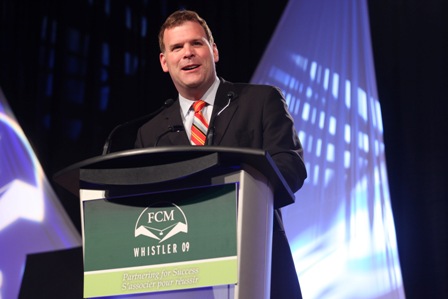
John Baird, Canada's Minister of Transport and Infrastructure to the Federation of Canadian Municipalities' 72nd Annual Conference
Introduction
Thank you very much.
Good afternoon everyone. C'est un grand plaisir pour moi d'être ici parmi vous cet après-midi.
First of all, I want to thank the President of the FCM, Jean Perreault, for inviting me today.
I also want to commend you for your leadership – as President of FCM and as Mayor of Sherbrooke.
I also want to congratulate your new President Elect, Summerside Mayor Basil Stewart. I'm sure the coming year will be an exciting one for you.
And, on behalf of Prime Minister Stephen Harper and our entire cabinet, I look forward to working with you over the next year.
Friends from both the FCM and the Canadian Urban Transit Association, I'm happy to be here today to provide you with an update on what we have accomplished together over the last several months.
And what few months it has been.
It's been a long time since Canadians have faced the kind of economic uncertainty we're facing today: uncertain and challenging economic times.
We know that Canada had nothing to do with the credit crisis that set this downturn in motion.
We also know that without collaboration and partnership on economic management, the impacts of the recession on Canada — as serious as they are — would be a lot worse.
These are extraordinary times for our economy.
These times require extraordinary leadership from those of us in government.
Leadership that puts aside partisanship and petty grievances.
An extraordinary commitment to partnership.
The federal government and provincial and territorial leaders have responded to that challenge and, together, we are delivering for the Canadian people.
In community after community, from Belledune, New Brunswick to Lévis, Quebec from Windsor, Ontario to West Vancouver, BC, together we are making things happen.
My government most certainly knows that it cannot deliver the full benefits of our Economic Action Plan to Canadians by itself.
Partners from the Beginning
From the get go, we recognized – and were told by you – municipal leaders from across Canada, that a stronger, cleaner, more prosperous Canada starts with stronger, cleaner, and more prosperous communities.
I recognize how important investment in public transit is to reducing congestion and helping the environment.
I know how important water and sewer investments are to the quality of our water in Canada.
I know that good roads and bridges are essential investments to keep our economy strong.
And, that culture and recreation support are essential to our quality of life as Canadians.
I also know municipalities can't deliver it all on their own.
That they can't be expected to get the job done without the financial support of the provinces and the federal government.
We heard you.
We answered like no federal government has ever answered before — $33 billion over seven years.
More than half of that has been committed specifically and directly to Canada's municipalities.
Economic Action Plan
But as we all know, things have changed over the last couple of years.
In 2007, we announced $33-billion over seven years in long-term, predictable funding for infrastructure.
Then, late last year, we all witnessed the sudden downturn in the global economy.
As a government, we had a responsibility to act.
We moved quickly.
In December and early January, I consulted with my counterparts in provinces and territories.
I also met with the FCM and heard from municipal associations across Canada.
We listened, and we responded with an Economic Action Plan that addresses Canadians' priorities.
We are making investments that are stimulating our economy and creating jobs that will also be the foundation for an even stronger and more prosperous Canada in the future.
In other words, when Mayor Perrault told us in January that we must include infrastructure funding in our Economic Action Plan, we listened and we responded.
Our approach is on two tracks.
First, we are undertaking a major acceleration of existing infrastructure funding.
We developed a five-point action plan that responds to the needs of municipal government.
- We changed the Navigable Waters Act to speed up projects.
- We responded to the call for major changes in environmental assessments. In 90% of cases, one EA will suffice. We don't need 2 or 3.
- We also have sought to streamline the federal process to be more responsive to you.
Let me be direct.
The era of micro-management by big government in Ottawa is over.
We respect jurisdiction – and this is a huge vote of confidence in the capacity and abilities of provincial and municipal governments.
Second, we have committed almost $12 billion in new funds for infrastructure.
Some of that includes the new $4-billion Infrastructure Stimulus Fund; a $500-million top-up of the Communities Component of the Building Canada Fund; and up to $1 billion in accelerated payments under the Provincial-Territorial Base Fund.
Accelerating Infrastructure Funding
So in the 4 months since the Budget, what have we accomplished?
We've rolled-up our sleeves and worked with our provincial and territorial partners to cut red tape, and put projects on the fast track.
Let me give you some more specifics.
Major Infrastructure Component
Since January, we've announced 54 major projects under Building Canada with over $1.9 billion in federal funding.
Projects like:
- the Evergreen Transit Line between Burnaby and Coquitlam
- the Niagara Centre for the Arts in St. Catharine's, Ontario
- water treatment in Thetford Mines, Quebec
- a wind farm in Summerside, PEI.
These are major municipal projects that create jobs and generate new economic activity.
We have been also able to commit funding to a number of major transit projects that will benefit Canadians across the country.
We are fast-tracking an unprecedented number of projects.
Your input, suggesting where and how we could do things better, was invaluable and critical to the success of these initiatives.
Evidence of Progress
During that time, we have also moved with unprecedented speed to roll out the new infrastructure funding announced in Budget 2009.
Infrastructure Stimulus Fund
The $12 billion in new infrastructure funding and matching provincial, territorial and municipal funds will see us spend and extra 24 to 36 billion dollars over the next two years.
We have moved 10 times faster than ever before in getting these programs up and running.
I believe the one page application form that we have used in some provinces is the way of the future.
I want to tell you that when we make a municipal infrastructure announcement under our stimulus fund municipalities can begin spending money immediately.
They don't have to wait for months of approvals.
And we are now able to advance 25% of the first year's funding up front to help you manage costs.
These actions are unprecedented. And are designed to make things happen.
I need to acknowledge the tremendous effort and hard work of my officials at Infrastructure Canada for their diligence.
Overall, we've committed $2.6 billion of the $4-billion Fund.
Since January, we've announced funding to some 1,600 projects worth over $6.3 billion.
Most recently, last Friday in Ontario we made one of the largest infrastructure announcements in our country's history with almost $3.4 billion in joint investments – that's federal-provincial-municipal funding – for key municipal infrastructure projects.
In record time, we worked with the province to develop a short, web-based application form.
The call for applications went out mid-April with a May 1st deadline.
We received over 2,700 applications, which we reviewed in record time.
Barely a month after the close for applications, we announced close to 1,200 projects and got people working on roads, bridges, parks, public transit systems and more.
The Fund is also rolling out across Canada.
Here in BC, we've already announced more than $290 million in joint funding from the Stimulus Fund.
In Nova Scotia, we've announced $83.8 million in joint federal-provincial stimulus funding.
We've announced more than $106 million in joint stimulus funding in Newfoundland and Labrador.
We've set aside $3.5 million in federal funding from the Stimulus Fund in the Yukon, and we announced more than $177 million in joint stimulus funding in Manitoba.
In Quebec, we've just announced that we're setting aside $936 million in federal funding from the Stimulus Fund.
This includes $350 million – which is being matched by the province – to support repair and replacement of drinking water and waste water pipes in municipalities throughout the province.
Communities Component
We're encouraging our partners in the provinces to ensure the $500 million top-up of the Communities Component of the Building Canada Fund rolls out just as quickly.
In Ontario, just this past Friday, we announced more than $408 million in joint federal-provincial funding under the Communities Component.
Most of this funding is from the Top-up we announced in our Economic Action Plan.
Many of these projects are scheduled to start this year.
This is in addition to the $687 million in joint federal-provincial funding we announced under Communities Component in Ontario on February 13.
In Nova Scotia, we announced more than three dozen projects from the Top-up.
In Alberta, a joint investment of more than $104 million for 40 projects will be funded under the top-up, and projects in Manitoba communities are in line for $58 million in federal funding, including more than $18 million from the top-up.
Recreational Infrastructure Canada
And we are ready to support more projects.
The Recreational Infrastructure Canada program is now in place, with a total of $500 million over the next two years to create jobs and make our communities healthier and more attractive places to live.
The call for applications was announced May 11th, and the final application deadline is June 19th – so I know we'll be hearing about projects under this fund very soon.
PT Base Funding
We're stepping up the availability of the provincial/territorial base funding.
Instead of $175 million per jurisdiction over seven years, if there are initiatives ready-to-go, we'll deliver that amount over the next two years.
Since January we have flowed $333 million to provinces to get shovels in the ground.
A lot of provinces and territories are using their funding for municipal projects, such as:
- a new wastewater treatment plant in Conception Bay South, Newfoundland and Labrador;
- Water treatment in Cheticamp, Nova Scotia and Fort Good Hope, Northwest Territories;
- Wastewater treatment in Blainville, Quebec; and
- A multiplex in Moose Jaw, Saskatchewan.
All are initiatives that will generate economic activity, create jobs and stronger communities.
Knowledge Infrastructure Program
We launched the Knowledge Infrastructure Program in March to enhance the infrastructure of our community colleges and universities.
Up to $2 billion more dollars over two years is available.
Projects under this program are underway across Canada as well.
Gas Tax Fund
In early April, our Government delivered to municipalities when federal gas tax transfers to the provinces and territories for municipal infrastructure doubled on April 1, 2009 to a total of $2 billion.
We also took action to get this additional money to your municipalities faster when we advanced the first payments under the Gas Tax Fund by three months.
By delivering these gas tax fund cheques in early April, we gave the provinces and territories nearly $1 billion in fast tracked funding so you can get that money and get Canadians working immediately.
Municipal Infrastructure Lending Program
Housing investments are central to Canada's Economic Action Plan. Through this plan, the Government of Canada will provide $7.8 billion to build quality housing, stimulate construction, encourage home ownership and enhance energy efficiency.
This includes the Municipal Infrastructure Lending Program (or M-I-L-P).
This new program, administered by Canada Mortgage and Housing Corporation (CMHC), offers municipalities across the country up to $2 billion in direct, low-cost loans for housing-related infrastructure projects.
These loans can also be used by municipalities to fund their contribution for cost-shared federal infrastructure programming such as the two-year, $4-billion Stimulus Fund.
The Municipal Infrastructure Lending program is up and running and CMHC is accepting applications for projects that are ready-to-go.
Today, I'm happy to announce that two cities in Saskatchewan are the first to be approved for loans and the money is ready to flow.
The city of Saskatoon has been approved for loans of more than $33 million to build a new water intake treatment plant and to develop new residential green space.
The city of North Battleford has been approved for a $2.5-million loan for sewer replacement.
These investments will not only improve the communities of Saskatoon and North Battleford, they will also create jobs and work for small businesses.
Conclusion
As the world struggles with the effects of global recession, we Canadians are looking ahead.
We are aggressively funding initiatives in communities across the country, initiatives that will generate economic growth for many years to come.
I don't want to over-use the word, but these are truly historic investments in infrastructure.
2009 will be a banner year for municipal infrastructure.
In a tough economic year, we kept our promise to municipalities to double the gas tax, to vastly accelerate Building Canada, and to invest major new money in stimulus while cutting red tape in a big way.
That's a huge vote of confidence in municipal government.
The doubters and critics said municipalities wouldn't have the shovel-ready projects… that municipalities couldn't move that fast.
They said they wouldn't – and couldn't – bring money to the table.
Well, we knew that the big cities and small towns were up to the challenge – and you have proven us right.
As a matter of fact, we should be inspired by the Olympic spirit and motto which will guide the athletes who will converge on Whistler a few months from now.
By working together we can be swifter; we can go higher, and our municipalities and country can become stronger.
I have every confidence that, with your ongoing support and partnership, we will get there.
Allow me to close with "un grand merci" to Mayor Perrault for his leadership.
We have had many useful – and even lively or spirited discussions – since I assumed this ministry.
I have appreciated his insights and his advice as we tackle together – Canada's infrastructure challenges.
I would also like to once again congratulate President Elect, Mayor Basil Stewart of Summerside, PEI, and I look forward to us working together.
Thank you very much, Merci beaucoup.
[And now, I would be pleased to take a few questions.]
- Date modified: