ARCHIVED - Building Canada: Long-Term Federal Support for Municipal Infrastructure
Archived Content
Information identified as archived is provided for reference, research or recordkeeping purposes. It is not subject to the Government of Canada Web Standards and has not been altered or updated since it was archived. Please contact us to request a format other than those available.
Slide Presentation at the FCM Annual Conference
Quebec, June 1st, 2008
3:00 – 4:30 pm
Infrastructure Canada
Note: Since the delivery of this presentation, other framework agreements have been signed and the Communities Component launched in more provinces. To find information specific to a province or territory, visit Infrastructure in My Region.
CONTEXT: Infrastructure Challenges & the Building Canada plan
The Age of Canada's Infrastructure
- In 2007, the average age of Canada's public infrastructure reached 16.3 years, down from its peak of 17.5 in 2000.
- The average age of public infrastructure has been falling almost steadily in most provinces for the past seven years.
- This rejuvenating trend was fuelled mainly by large investments in highways and roads in Quebec and Ontario.
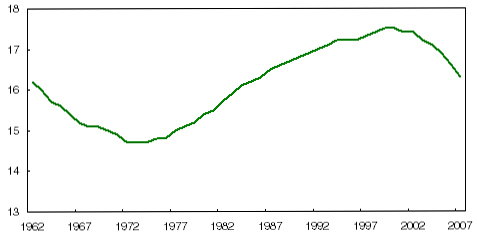
Source: Statistics Canada, special tabulation, Investment and Capital Stock Division
By international standards Canada is in good standing…
The 2006 World Economic Forum (WEF) Report on Global Competitiveness shows us that Canada's infrastructure is comparable to that of Belgium, the United States, and the United Kingdom.
WEF Infrastructure Index, 2006-07
| Country | Score (out of 7) |
|---|---|
| Germany | 6.51 |
| France | 6.25 |
| Japan | 6.1 |
| Netherlands | 6.09 |
| Belgium | 5.85 |
| U.S. | 5.82 |
| Canada | 5.81 |
| U.K. | 5.74 |
| Norway | 5.41 |
| Korea | 5.38 |
| Itlay | 4.0 |
| China | 3.54 |
| Russia | 3.52 |
| India | 3.5 |
| Mexico | 3.41 |
| Brazil | 3.29 |
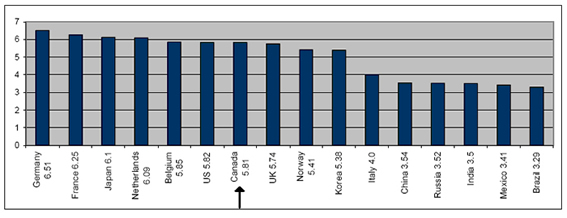
Source: 2006 Report on Global Competitiveness, World Economic Forum
Need to continue to invest…
Modern and efficient infrastructure plays a critical foundational role in:
- Supporting a competitive economy
e.g. getting our goods to market – quickly and efficiently, attracting private sector capital and expertise
- Protecting our environment
e.g. cleaner water and air
- Supporting strong and prosperous communities
e.g. quality of life in Canada's communities is important in attracting skilled workers
And there are significant pressures…
- Since the 1960s and '70s, infrastructure investments have decreased significantly relative to Canada's gross domestic product due to:
- Regional discrepancies in infrastructure capital stock (value, type);
- Declining federal, provincial and territorial infrastructure capital stock but increasing for municipalities; and
- Increasing concerns about public safety (roads, overpasses, bridges, clean water, etc…).
- Despite recent investments, the age of existing infrastructure increased substantially over the last three decades.
- Economic, environmental and social trends are creating pressures for new infrastructure investments, such as:
- Trade, access to jobs and services, climate change, urban sprawl, stressed neighbourhoods and immigration/urban sprawl/diversity.
Addressing our Infrastructure Challenge
Since its creation in 2002, Infrastructure Canada, through a number of initiatives, has made key investments in large scale infrastructure projects as well as supported thousands of important initiatives at the local level.
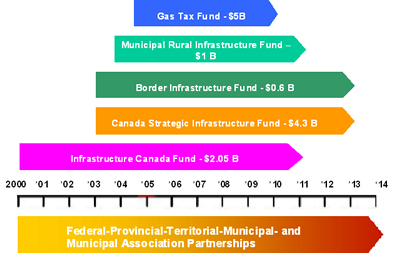
Below is a summary of the funding commitments that were made by the Government of Canada before the Building Canada plan was launched.
Federal-Provincial-Territorial-Municipal- and Municipal Association Partnerships
- Gas Tax Fund – $5 Billion (2005 to 2010)
- Municipal Rural Infrastructure Fund – $1 Billion (2004 to 2011)
- Border Infrastructure Fund – $0.6 Billion (2003 to 2013)
- Canada Strategic Infrastructure Fund – $4.3 Billion (2003 to 2013)
- Infrastructure Canada Fund -– $2.05 Billion (2000 to 2011)
In 2006, the federal government undertook consultations on infrastructure, which included the Federation of Canadian Municipalities (FCM), and what we heard was need for:
- Increased, long-term, predictable funding
- Flexibility
- Streamlined programs
- Streamlined reporting requirements
In response, the Government of Canada announced the Building Canada plan:
- Unprecedented long-term commitment of $33B for infrastructure
- Suite of flexible programs and initiatives that balances regional needs with national priorities
- Includes base funding, distributed program funding, and targeted program funding
- Programs that will support infrastructure in large and small communities across Canada
- Complemented by recent Budget 2008 announcements (permanent extension of the Gas Tax Fund and public transit trust worth $500 M)
Building Canada Plan
Program Overview
See: Building Canada -– An Overview
Policy Framework
Vision
Building a stronger, safer and better Canada through modern world-class public infrastructure
Themes
- Growing the Economy
- Clean Environment
- Strong & Prosperous Communities
Objectives and Outcomes
Theme 1: Growing the Economy
Objectives- Support economic growth and productivity
- Improve Canada's competitiveness
- Facilitate trade
- Growing the Economy
- Increasing productivity
- Increasing access to eCommerce and eLearning
- Increasing Trade
- Facilitating trade through gateways and corridors
- Moving Goods and People
- Improving the efficiency and integration of Canada's transportation networks
Theme 2: Clean Environment
Objectives- Promote sustainable growth
- Improve the quality of Canada's air, water and soil
- Clean Air
- Reducing greenhouse gas emissions and air pollutants
- Increasing use of green energy
- Clean Water
- Improving source water protection
- Reducing quantity of untreated wastewater
- Clean Land
- Reducing solid waste being sent to Canada's landfills
- Encouraging efficient land use
Theme 3: Strong & Prosperous Communities
Objectives- Promote strong, competitive and sustainable Canadian communities
- Competitive Communities
- Cutting the commute
- Developing cultural industries
- Increasing access to rural & remote communities
- Livable Communities
- Increasing access to safe drinking water
- Protecting against natural disasters
- Improving urban development
- Providing greater access to sports facilities
Building Canada Plan: Suite of Programs/Initiatives
Building Canada Fund (BCF)
The $8.8-billion BCF will help provinces, territories and municipalities address key public infrastructure priorities.
It unifies the delivery of the currently distributed infrastructure program funding by replacing the existing Canada Strategic Infrastructure Fund (CSIF) and Municipal Rural Infrastructure Fund (MRIF) with a single program instrument.
The BCF will have a Communities Component (CC), for smaller, community-based projects, and a Major Infrastructure Component (MIC), for larger, strategic projects of national / regional significance.
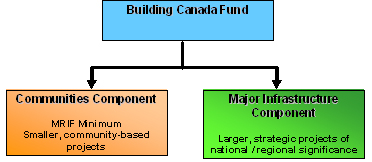
Up to 1% of funding will be made available for research, knowledge, planning, feasibility and other studies (cost-matched).
The specific split between the two components is set out in the Framework Agreements being negotiated with each jurisdiction (visit Infrastructure in My Region). However, it can be noted that the Communities Component allocation must be at minimum the MRIF allocation.
BCF Eligible Categories
There are 15 Building Canada Fund eligible categories under the BCF. These categories contribute to the overall national objectives of a growing economy, cleaner environment, and strong communities.
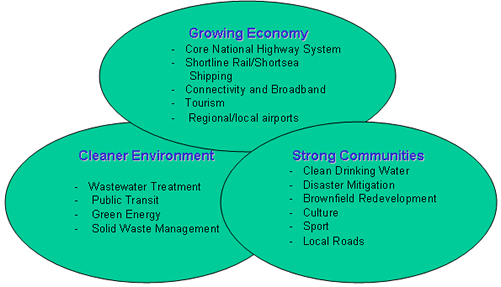
Of these 15 categories, 5 are considered to be national priorities:
- Core national highways
- Drinking water
- Wastewater
- Public transit
- Green energy
For a breakdown of categories and their respective funding criteria, see the backgrounder Funding Criteria under the Building Canada Fund.
BCF Major Infrastructure Component (MIC)
What is it?
- Program targeted at larger strategic projects of national and regional significance
– 67% of funding for national priorities
Who's eligible?
- Provincial, local or regional governments
- Including communities with a population under 100,000
- Public sector bodies owned by the province/municipality (e.g. transit commissions)
- Private sector
What's the cost-sharing?
- Maximum individual project federal share of total eligible costs = 1/2
- Involving municipalities = generally 1/3
- Involving private sector assets = 1/4
- Involving not-for-profit NGOs = 1/2
What's the process?
- The Infrastructure Framework Committee will present and discuss priorities
- Need to work with your provincial/territorial government
- Once priority identified, a formal due diligence of projects is done (assessment and business case)
- Working with the proponent
Improved features?
- Focus of 5 priorities (67% of funding nationally);
- Expansion of categories of investment to have the same categories for both the MIC and Communities Component; and
- No minimum threshold for projects but the Framework Agreements set out guidelines.
BCF Communities Component (CC)
What is it?
- Infrastructure program targeted at communities under 100,000 people
Who's eligible?
- Local/regional governments
- Public sector bodies that provide municipal services (e.g. transit commissions)
- Private sector bodies (application must be supported by local or regional government)
What's the cost-sharing?
- 1/3 federal, 1/3 provincial, 1/3 municipal
- When project includes private sector assets the federal portion = 1/4
- Involving not-for-profit NGOs = 1/2
What's the process?
- Competitive, application-based process
- Projects selected jointly by an Oversight Committee
Responding to municipal needs
- Focus on smaller communities (100,000 vs. 250,000)
- Same categories as Major Infrastructure Component
- Simplified on-line application process
- Working to simplify environmental assessment process
Gas Tax Fund (GTF)
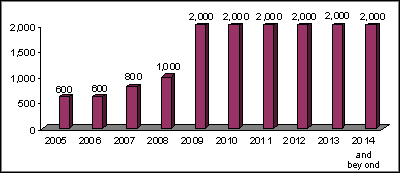
- Budget 2007 extended the GTF at $2 billion per year from 2010 to 2014.
- Federal- provincial/territorial GTF Agreements are being amended to build in funds for 2010-2014 and confirm allocation formula for municipalities to allow them to undertake long term planning.
- Budget 2008 announced that the GTF was to be made a permanent measure at $2 billion per year after 2014.
GTF Annual Allocation
What's the process?
- Province/ territory receives funds twice a year from Canada.
- Municipalities receive funding from province/ territory once municipality and province/ territory have signed a funding agreement.
- Municipalities undertake projects.
- Municipalities report annually on use of funds.
- Province/ territory aggregates information and reports to Canada.
- Province/ territory required to produce an Outcomes Report in 2009.
- Canada to complete national GTF evaluation in 2009
Equal per Jurisdiction ("Provincial-Territorial Base" or "PT Base") Funding
What is it?
- Budget 2007: $25 M per year ($2.275 B over 7 years) for each province and territory
What's eligible?
- PT Base Funding eligible categories = BCF eligible categories + Non-core National Highways + Safety-related Rehabilitation
Who's eligible?
- Funding flows to the provinces and territories, but the ultimate recipients can include municipalities
What's the process?
- PTs will submit an annual plan for the funding each year
What about the territories?
- All BCF funding for the territories will be administered under this Fund
- At least $16 million in each territory to be available for community-based infrastructure
Gateways and Border Crossings Fund (GBCF)
What is it?
- $2.1B national program to fund international gateways, trade corridors and border crossings
What's eligible?
- Core highways, border crossings, intermodal connectors and facilities, international bridges and tunnels, rail/road grade separations, air-rail links, shortline rail, shortsea shipping, ITS
- Non-infrastructure initiatives, such as gateway marketing and promotion, gateway research
- Minimum of $400 million reserved for the new Highway 401 access road to the Windsor-Detroit border crossing
Who's eligible?
- Provinces, territories, municipal governments, not-for-profit organizations and the private sector
What's the process?
- Regional approach:
- Working with provinces on development of Ontario-Québec Continental Gateway and Atlantic Gateway (Memorandum of Understandings signed), and Pacific Gateway
Public Transit Capital Trust 2008
What is it?
- Budget 2008 announced $500 million for capital infrastructure, such as rapid transit, rail, transit buses, and high-occupancy vehicle and bicycle lanes
Who's eligible?
- Funding allocated on a provincial-territorial per capita basis
What's the process?
- Funding paid into a third-party trust to beneficiaries that made public commitments before March 31, 2008
PTCT allocation by Province/Territory
| Province/Territory | Total ($ millions) |
|---|---|
| Newfoundland and Labrador | 7.6 |
| Prince Edward Island | 2.1 |
| Nova Scotia | 14.0 |
| New Brunswick | 11.3 |
| Quebec | 116.3 |
| Ontario | 194.9 |
| Manitoba | 17.9 |
| Saskatchewan | 14.9 |
| Alberta | 52.9 |
| British Columbia | 66.7 |
| Yukon | 0.5 |
| Northwest Territories | 0.6 |
| Nunavut | 0.5 |
| Canada | 500.2 |
Public-Private Partnerships (P3s)
What is it?
- $1.25-billion P3 Fund: will invest in P3s using a range of innovative financing instruments, such as loans, loan guarantees, non-voting shares and repayable contributions
- Budget 2008 announced the creation of PPP Canada Inc.
- Finance Canada is taking the lead in developing P3 initiatives
What's eligible?
- The P3 Fund will target the same categories of projects as the BCF
What's the process?
- This is a national fund, with parameters being developed
What's the P3 Screen?
- Proponents seeking over $50M under the BCF and GBCF will have to demonstrate that P3s have been considered
Framework Agreements
- High-level umbrella agreements to cooperate and coordinate on infrastructure issues and programs:
- Demonstrates both Governments' commitment to infrastructure
- Will promote accountability by providing Canadians with regular public reporting on the implementation and outcomes
- Allows for establishment of high-level federal/ provincial/ territorial governance structure to guide subsequent negotiations and provide a forum to discuss priorities
- Allows for streamlining of subsequent contribution agreements
- In provinces, specifies split between Major Infrastructure and Communities Components
- As of June 1, signed Framework Agreements with Newfoundland and Labrador, Prince Edward Island, Nova Scotia, New Brunswick, British Columbia, Yukon, Northwest Territories and Nunavut.
- Ongoing discussions with other jurisdictions.
Building Canada Plan: Strengthening Knowledge and Capacity
- Working with partners to promote knowledge, research, best practices, long term planning and capacity building
- Up to 1% of funding under the MIC and the Communities Component under BCF in each jurisdiction can be used for cost-shared projects
- $45 million national level program to support research, planning and feasibility studies
- Gas tax funds can be used for capacity building including Capital Investment Plans and Integrated Community Sustainability Plans
Building Canada: Strengthening Partnerships
Building Canada is a strengthened national partnership aimed at modernizing Canada's infrastructure.
- Provinces/Territories: partners in setting overall priorities, signing framework and funding agreements, research, funding and program delivery
- Municipalities: partners in setting local priorities, funding, research, program delivery, infrastructure project management and improving community sustainability
- Municipal Associations: partners in setting regional priorities, delivery of the Gas Tax Fund, and identifying municipal priorities
- Other Stakeholder Organizations: partners in research and planning (e.g. on the state of infrastructure through the National Roundtable on Sustainable Infrastructure)
Building Canada Plan: Conclusion
How Building Canada Responds
- Largest single federal commitment, over the longest period of time
- Suite of programs so that that we can respond to unique needs and capacities of smaller urban, rural, remote and northern communities
- Permanent GTF means ongoing predictable funding for municipalities
- Expanded investment categories providing greater flexibility to respond to local needs
- Eliminated targets under community-based programs and major project thresholds
- Work underway to streamline environmental assessment and reporting processes of Communities Component
- Increased support for local capacity-building, research, sharing of best practices
- Date modified: